The Way Back

The Way Back

My name is Chris Markt. I am a husband, a father, and a former business executive whose life was upended by a complex multi-system neurological illness.

For years, I lived with worsening symptoms, conflicting diagnoses, and no clear explanation for what was happening to me. After six years of searching, we are finally beginning to understand how the pieces fit together and what a path toward recovery may look like.

Thank you to my brother Kyle Markt and step father Phil Thornton for putting together this site and leading the effort to raise support for me and my family.

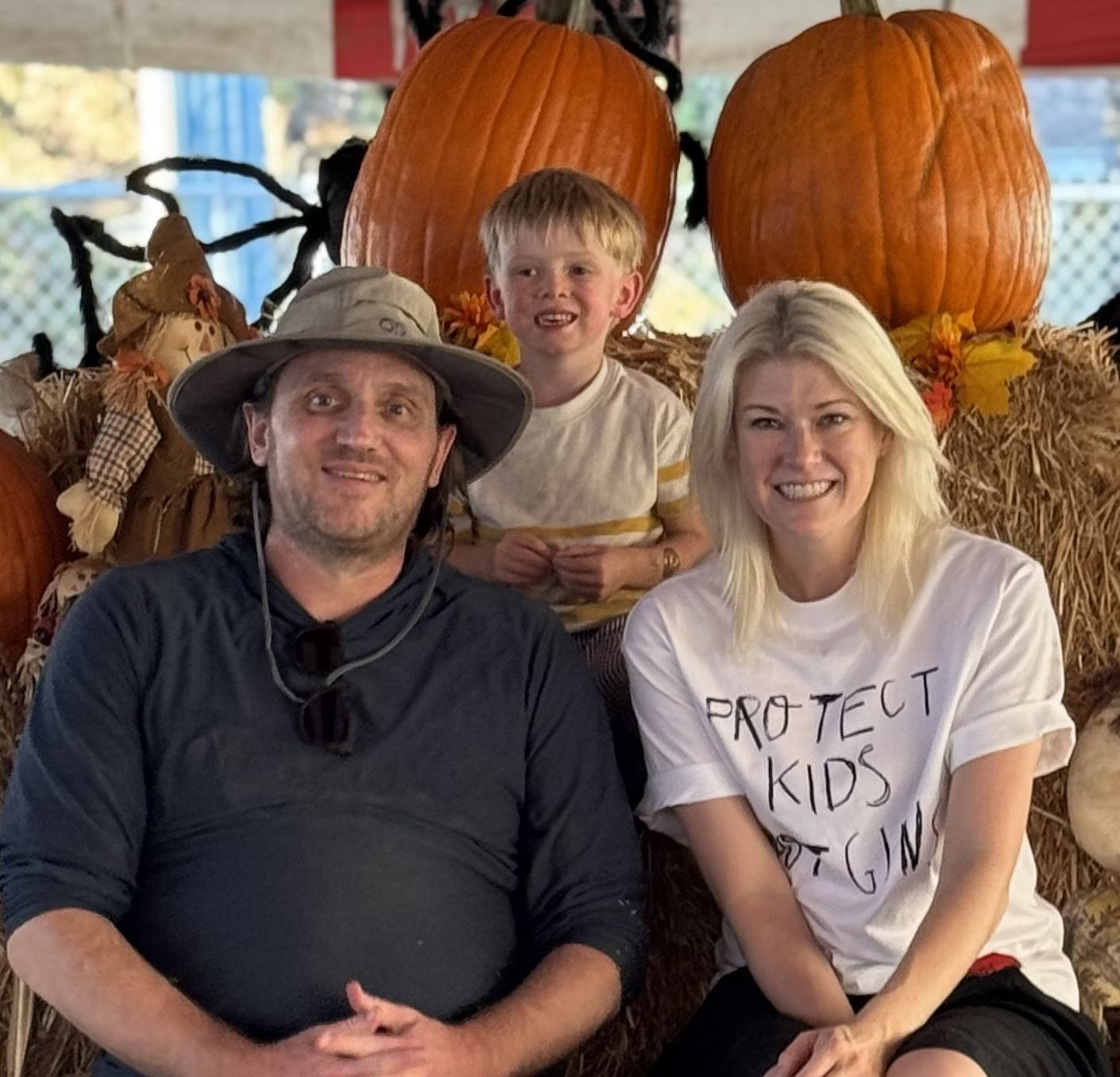
Portrait of resilience - a person in natural light looking thoughtful

My Reality

In 2020, my health finally collapsed.

What began 10 years earlier as unusual facial pain and vision problems evolved into a complex illness affecting my nervous system, connective tissue, blood flow from my brain, immune system, energy production, and autonomic function.

What I am suffering from is a multi-systemic connective tissue disorder that manifests in different ways across the body. For years, that made it incredibly difficult to figure out what was actually happening to me, since connective tissue is everywhere.

Our medical system is siloed inside specialties, and there is no specialty that oversees connective tissue disorders. I found doctors who could address individual symptoms, but very few who could understand how these systems were interacting. I went from specialist to specialist, sometimes misdiagnosed, sometimes told symptoms were stress or in my head, and sometimes treated in ways that simply did not help. The brain fog and exhaustion made it even harder to research, advocate for myself, and keep searching for answers.

Through a lot of hard work, I have been able to cobble together a network of medical professionals who have helped with diagnosis and treatment protocols, as they have taken a special interest in connective tissue disorders. In all honesty, I have been the one spearheading and overseeing much of this process. Almost all of the doctors doing the most promising work in this area are not covered by insurance. The primary treatments for the joint issues caused by my faulty connective tissue are all out of pocket and cost prohibitive.

Today, I spend most of my life managing symptoms, medical appointments, treatments, and recovery. Some days, simply leaving the house requires hours of preparation.

What Chronic Illness Took From Our Family

When Lauren and I met, our life looked very different.

I worked full time (and then some). We traveled a lot. We were building a future together and we were so happy. We assumed that when we eventually had children, I would be the kind of father who coached teams, went on camping trips, chased kids around the yard, and showed up for every school event.

Instead, much of our marriage has been spent navigating a medical mystery.

Lauren has had to carry a huge burden since the onset of my illness, becoming a caregiver, while pursuing her own career goals, and raising our son. She has three jobs, and she is exhausted.

My biggest hope is not simply to feel better —

It is to give Lauren more of the husband she married, and some space to breathe. And I desperately want to give Finn more of the father he deserves.

Finn is now at the age where he wants to explore everything.

He wants someone to run beside him, wrestle on the floor, climb playgrounds, go on adventures, and experience the world together.

I want all of those things too.

Some days I can do them. Many days I cannot.

The cruel reality of chronic illness is that children do not understand why a parent cannot participate. They only know whether Dad can come or Dad cannot come.

Every treatment, surgery, specialist consultation, and therapy we pursue has the same ultimate goals:

More time.

Less pain.

More energy.

More participation in family life.

More opportunities to be the father I want to be while Finn is still young enough to need me.

I left work in 2020 and have been unable to return. Until that point in our marriage I had been the sole or primary breadwinner. Fortunately, I had a long term disability policy, but it pays a fraction of what I used to earn. To Lauren's credit she stepped up and started her own consulting business that sustained us for a few years, while I fought the insurance company to pay the benefits. Eventually the consulting income was drying up, so we moved back to LA where she has the best career prospects. In 2025 I was granted Social Security Disability and Medicare. This has pros and cons that are too specific to address here.

The past six years have been marked by frustration, isolation, misdiagnosis, misunderstanding, and debilitating illness. And now, finally, there are several glimmers of hope. I am one of the lucky ones. We finally have diagnoses, a clearer understanding of what I am facing, and, for the first time, a way back.

Back to being me. Back to being present for my friends and family. Back to contributing to the world around me. Back to a life that, for a long time, felt impossibly far away.
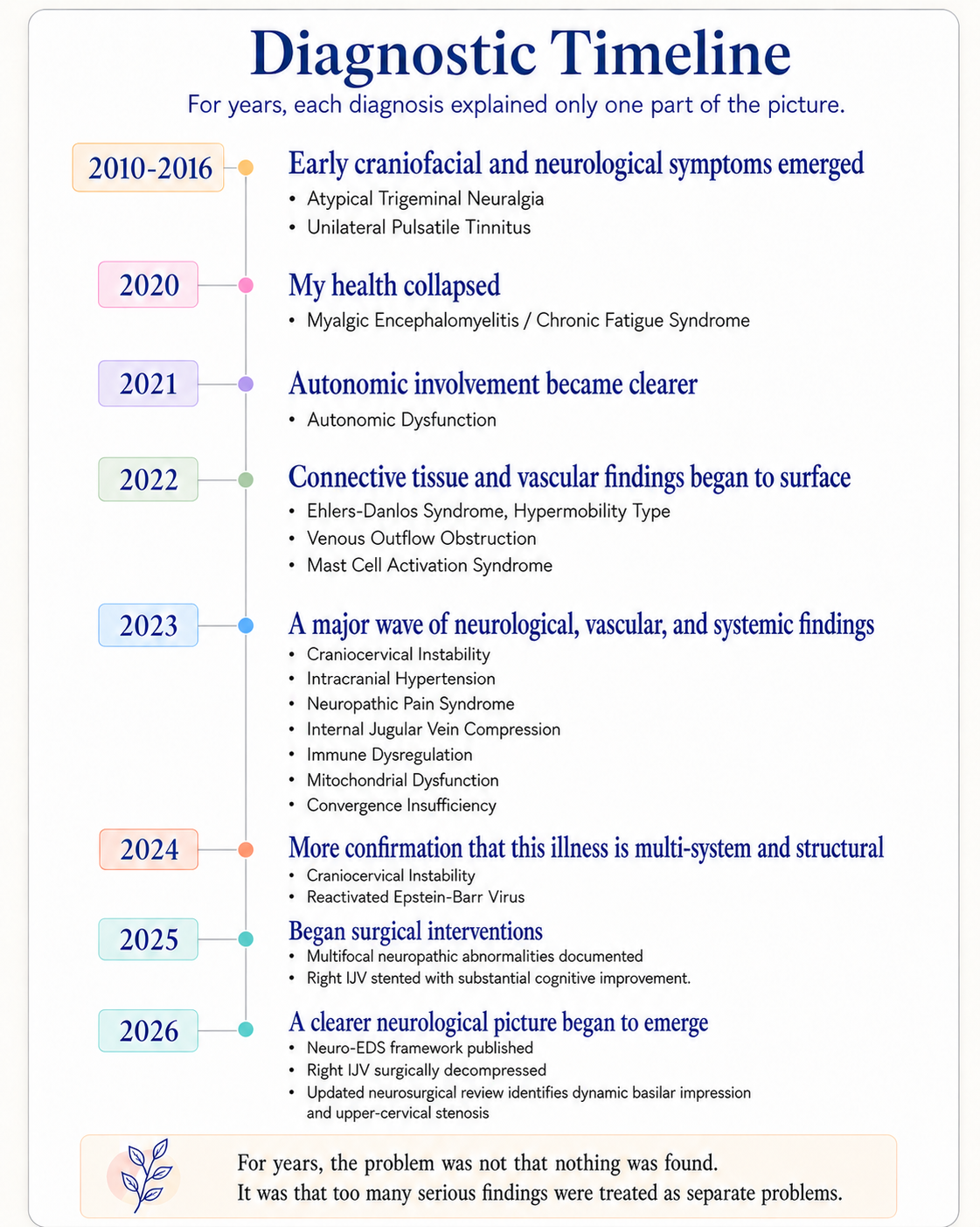
Timeline and progression of diagnosis over years of medical evaluation and specialist consultations

Where Things Stand Now

I've spent years seeing specialists, trying treatments, taking medications, and searching for answers. Some things have helped. Many haven't. Living with an illness that affects nearly every system in your body is exhausting in ways that are difficult to explain.

Every day starts with pain, and every decision—working, driving, exercising, traveling, even spending time with friends and family—has to be weighed against how much it will cost me physically afterward.

From the outside, I often look healthy. On the inside, my body is constantly fighting itself.

But there has been a major development.

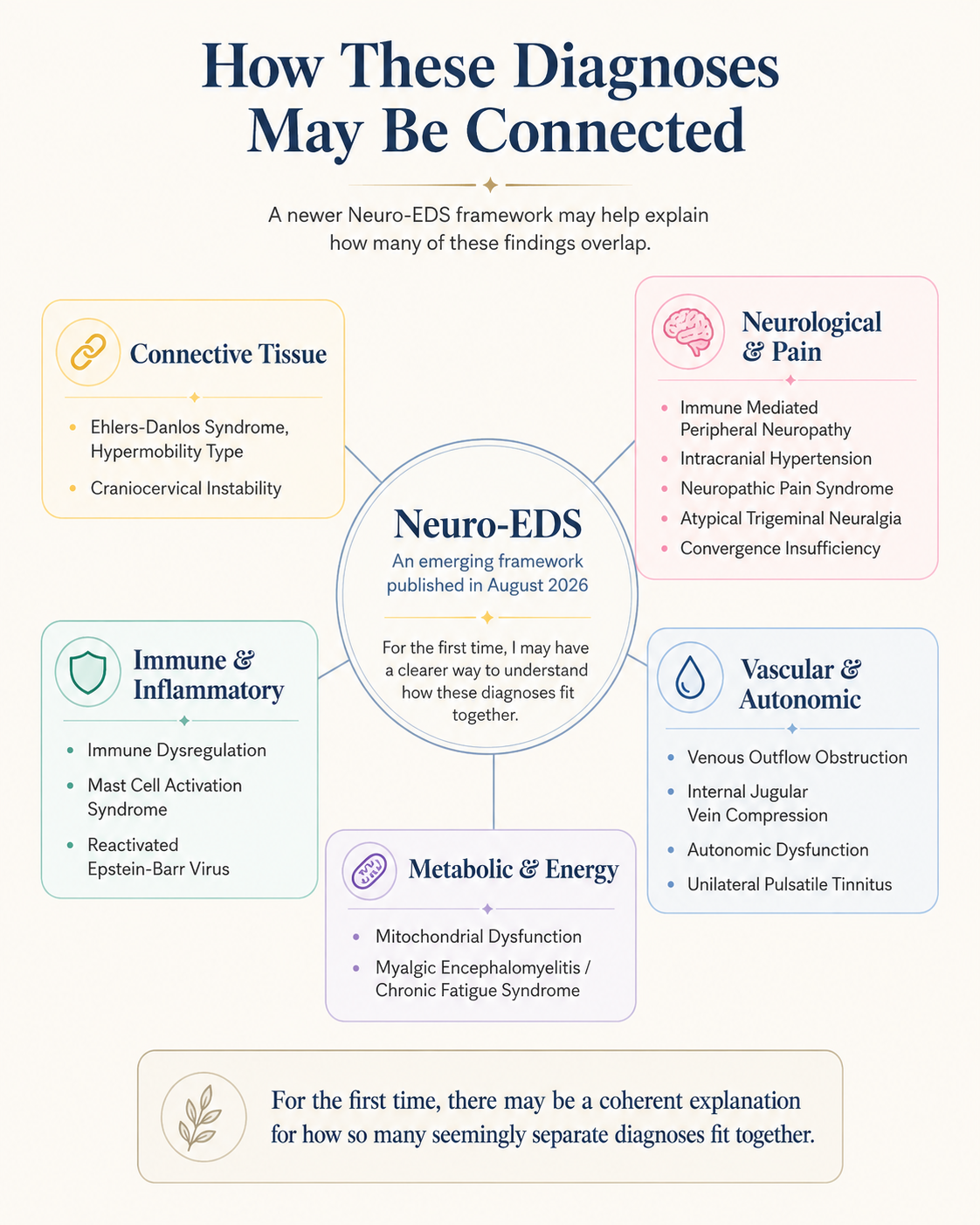
In August 2026, a multidisciplinary group of physicians and researchers—including two doctors involved in my care—released a preprint position paper proposing a framework they call Neuro-EDS. It describes a neuro-predominant phenotype within hEDS/HSD in which cranial, spinal, vascular, autonomic, inflammatory, neuropathic, and fatigue-related manifestations may occur together.

When I compared the framework with my medical history, I found that roughly 30 of my approximately 50 diagnoses and significant findings appear to fall within the paper's two proposed domains.

For the first time, it feels like we are moving from a long list of disconnected diagnoses toward a clearer understanding of the underlying disease process.

That is incredibly encouraging—but it also shows how new this field still is. Neuro-EDS is an emerging framework, not yet a settled diagnosis or established medical consensus.

I'm stubborn. Probably to a fault. I keep working, keep showing up, and keep pushing when my energy levels permit, because I believe there is still a path forward. I am mentally strong right now and thinking clearer than I have in years.

The difference now is that two major procedures have helped and the path ahead is finally becoming clearer. I no longer need someone to solve a medical mystery for me, I just need enough help to keep moving toward getting my life back.

Visualization of interconnected medical systems and the Neuro-EDS framework linking neurological, vascular, immune, and connective tissue conditions

The Next Two Years

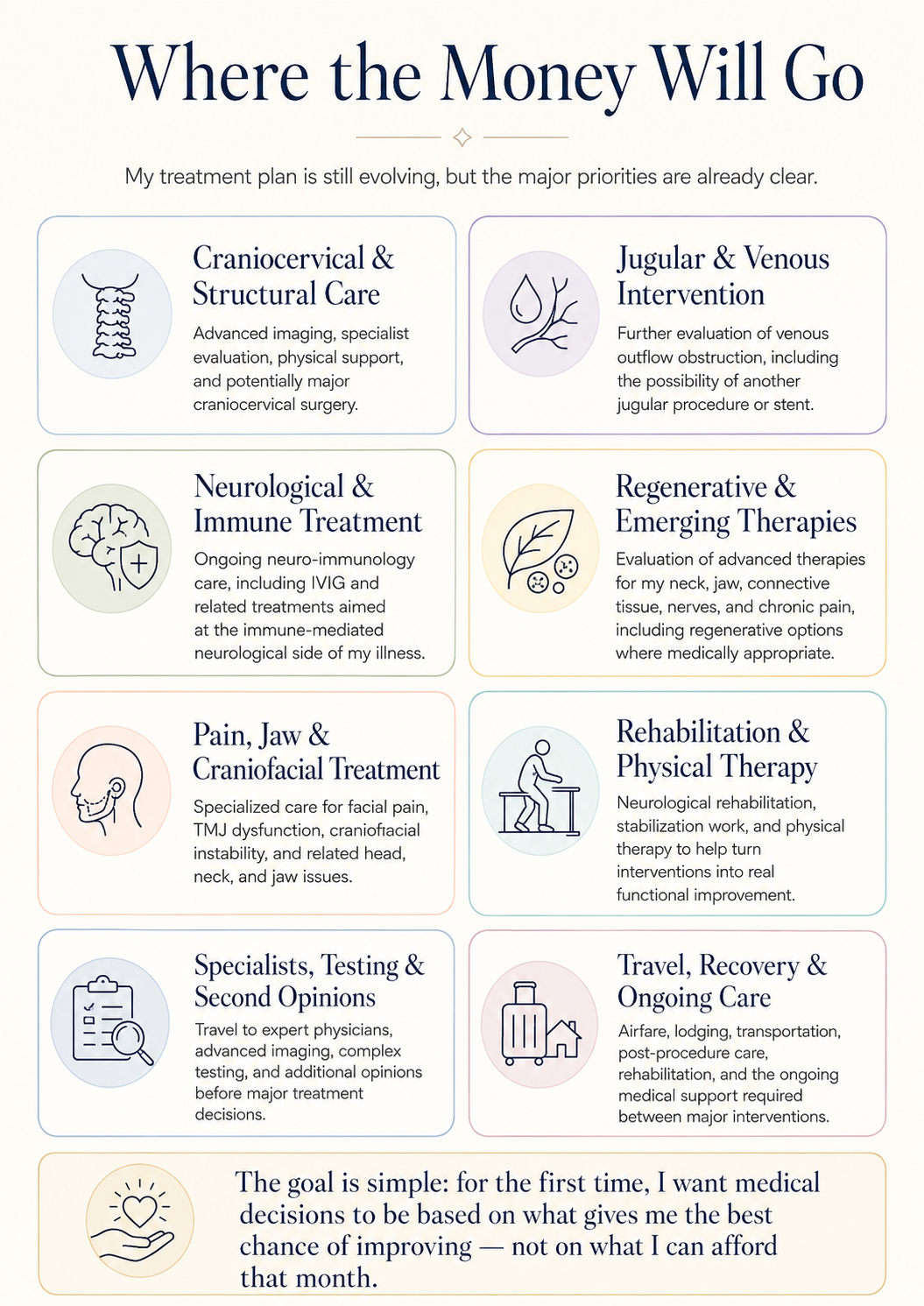
The last few years have finally brought clarity to what has been happening to my body. After years without clear answers, I began receiving diagnoses that explain much of my condition and gave us a more defined path forward. Since then, we have pursued the most accessible options first: testing, rehabilitation, consultations, procedures, and treatments available first through insurance and then Medicare. Much of that low-hanging fruit is now behind us.

The next two years will be different. The care I need is becoming more specialized, more complex, and far more expensive. Meaningful recovery will require physicians and surgeons with experience in Ehlers-Danlos syndrome, neurological and vascular complications, and disorders of the upper cervical spine. In some cases, surgical intervention may be necessary. Even when these procedures are covered, travel, lodging, second opinions, rehabilitation, and out-of-network supportive care can add significant costs.

We will also continue evaluating emerging treatments as the science develops, including regenerative approaches that will play a role in my care. These options have been approached carefully and with qualified specialists, but they are part of a rapidly evolving field that may offer additional possibilities over time.

The reality is that first Lauren and I spent every dollar we had on care and then my family has stepped in and carried the financial burden of getting me this far, and we are now tapped. The next two years are about accessing the level of specialized care that offers me the best chance of meaningful recovery.

Representation of coordinated medical care, specialized treatments, and evidence-based recovery strategies for complex chronic illness

For Those Who Can Contribute

If you have made it this far, you now understand how complicated this journey has been — and how hard my family and I have fought to get to this point.

It has taken years of research, advocacy, specialist visits, testing, procedures, trial and error, successes, and setbacks to finally understand what is happening and what may be possible from here.

There is no simple cure for what I have. I am living with a complicated, chronic illness involving multiple systems of the body, and much of the medicine surrounding these conditions is still evolving. But for the first time in years, we are no longer searching blindly. We have diagnoses. We have doctors who understand what they are looking at. We have treatment options. And most importantly, we have reason to believe that meaningful recovery is still possible.

That is what your support can help make possible.

It can give me access to the specialists, procedures, rehabilitation, travel, and ongoing care required to pursue the best treatment options available to me. It can give me the opportunity to keep moving forward with the medical team and plan we have worked so hard to assemble.

I also hope that what we learn through this process can help others. If the research, advocacy, mistakes, discoveries, procedures, and persistence behind my case can help another person with Ehlers-Danlos syndrome, chronic illness, autoimmune disease, or another poorly understood multisystem condition reach answers or effective treatment sooner, then this effort can have an impact beyond my own recovery.

I cannot know exactly where this road leads. But I finally know enough to believe there is a road worth taking.

Thank you for helping me take the next steps and for supporting me on The Way Back.

Help Hope Live Campaign

To ensure that every contribution directly supports my medical needs, my family and I have partnered with Help Hope Live, an established 501(c)(3) nonprofit dedicated to fundraising for people facing serious medical conditions.

Unlike traditional crowdfunding platforms, Help Hope Live requires medical verification and independently manages all donated funds. Contributions are reserved for eligible medical and related expenses, with payments made directly to providers or reimbursed against documented expenses.

This provides an important layer of accountability and transparency for everyone supporting my recovery. Donations are tax-deductible.

Research & Resources

FOUNDATIONAL

Defining Neuro-EDS: A Neuro-Predominant Phenotype in hEDS/HSD and Related Heritable Connective Tissue Disorders

An August 2026 position paper proposing the Neuro-EDS framework described in Chris's story. The paper explores a neuro-predominant phenotype within hEDS/HSD involving neurological, vascular, autonomic, inflammatory, neuropathic, and fatigue-related manifestations.

Note: This is a preprint/concept paper and has not yet been peer reviewed.

Read the Paper

Neuro-EDS Community & Resources

Neuro-EDS Community Website

The official Neuro-EDS community website providing information, resources, and connection for patients and medical professionals working with this emerging framework.

Visit the Site

Complex Chronic Illness

Mount Sinai Cohen Center IACI Provider Manual

Evidence-informed clinical guidance for infection-associated and multisystem chronic illness, including autonomic, neurological, immune, fatigue, and connective-tissue-related considerations.

View the Manual

Ehlers-Danlos & Craniocervical Instability

Regenerative Medicine

Hope Biosciences Research

Investigational research into regenerative medicine approaches, including mesenchymal stem cell therapies for complex inflammatory, neurological, and post-viral conditions.

View Research